
IPC 620 is the commonly used name for IPC/WHMA-A-620, the requirements and acceptance standard for cable and wire harness assemblies. It addresses workmanship in wire preparation, crimped and soldered connections, connector assembly, and associated inspection and testing. For a production order, the useful reference is not simply “IPC compliant”: it is the agreed revision, product class, drawing, and test requirements. Those details determine how an assembly is evaluated. At EBest Circuit, we supply custom wire harnesses alongside PCB and PCBA services, helping customers coordinate the cable and board connections in one manufacturing project.
Key Takeaways
- IPC 620 refers to IPC/WHMA-A-620, a cable and wire harness manufacturing and acceptance standard—not a bare PCB acceptance standard.
- Class 1, Class 2 and Class 3 distinguish end-use performance needs; the class is not a wire gauge or a connector current rating.
- The official English F revision is dated October 2025. The revision specified for the order governs acceptance; a new edition does not automatically change an existing contract.
- Crimp height, wire size, terminal identity and pull-test results must be considered together. A single pull-force result cannot describe the entire termination.
- Continuity checks establish electrical connections. They do not establish contact retention, insulation condition or the performance of a complete powered system.
- IPC 620 certification usually refers to personnel training and assessment. It does not replace inspection and test evidence for the delivered harness.
- For a harness connected to a PCBA, inspect both sides of the interface: the cable pinout and terminals, and the board connector orientation and solder joints.
What Does the IPC 620 Standard Cover?
The IPC 620 standard covers the manufacture and acceptance of cable and wire harness assemblies, including crimped, soldered and mechanically secured interconnections. Our wire harness assembly guide explains the production steps behind these inspection points. Its purpose is to give the customer and assembler a shared basis for judging workmanship.
A useful way to understand its role is to separate the finished cable from the circuit board and from the manufacturing process used to join parts:
| Document | Main application |
| IPC/WHMA-A-620 | Cable and wire harness requirements and acceptance |
| IPC-A-610 | Acceptance of electronic assemblies, including assembled PCBs |
| J-STD-001 | Requirements for soldered electrical and electronic assemblies |
| IPC-D-620 | Cable and wiring harness design and critical process requirements |
For example, a cable plugged into a board-mounted header creates two inspection tasks. The cable terminals and housing belong to the harness inspection; the header’s solder connections belong to the board assembly inspection. Specifying A-620 alone does not define every aspect of the finished electronic product.
What Are IPC 620 Classes 1, 2 and 3?
Class 1 prioritizes basic product function, Class 2 addresses sustained service, and Class 3 addresses critical operation or demanding environments. The following IPC 620 Class 1 2 3 definition summary is a practical orientation, not a replacement for the standard’s detailed acceptance criteria.
| Class | Performance priority |
| Class 1 | The completed assembly performs its intended function. |
| Class 2 | Longer service life and continued operation matter; interruption is undesirable but not critical. |
| Class 3 | Operation when needed is critical, downtime is unacceptable, or service conditions are unusually demanding. |
Select the class from the product’s actual failure consequences. A monitoring accessory and an emergency control circuit may be installed in the same machine yet have different reliability needs. An industry label such as “industrial” or “medical” is not enough to settle the requirement.
The practical manufacturing consequence is that inspectors need the class before evaluating a questionable condition. Changing it after samples are approved can change acceptance decisions and create avoidable rework.
What Is the Current Version of IPC 620?
The official English IPC/WHMA-A-620F publication is dated October 2025, superseding revision E. This version information was checked on October 16, 2026 against the Global Electronics Association’s public publication material.
A drawing that specifies revision E should not silently be changed to F. Resolve the revision with the customer and record the decision before production. The drawing revision and the standard revision are separate fields: updating a connector position on a drawing does not automatically update the acceptance standard.
What Should Be Checked on a Crimped Connection?
Check the terminal and wire combination, conductor capture, insulation support, crimp dimensions and mechanical strength. These checks answer different questions and should not be reduced to “the wire did not pull out.”
- Part match: confirm the terminal part number, conductor size, insulation diameter and specified tooling.
- Wire preparation: look for cut strands, spreading strands and insulation caught in the conductor crimp.
- Conductor crimp: check the formed barrel and measure height where required by the applicable application specification.
- Insulation support: verify that the rear support grips the jacket without damaging it.
- Mechanical evidence: use the specified pull-test setup; unintended support from the insulation grip can distort the result.
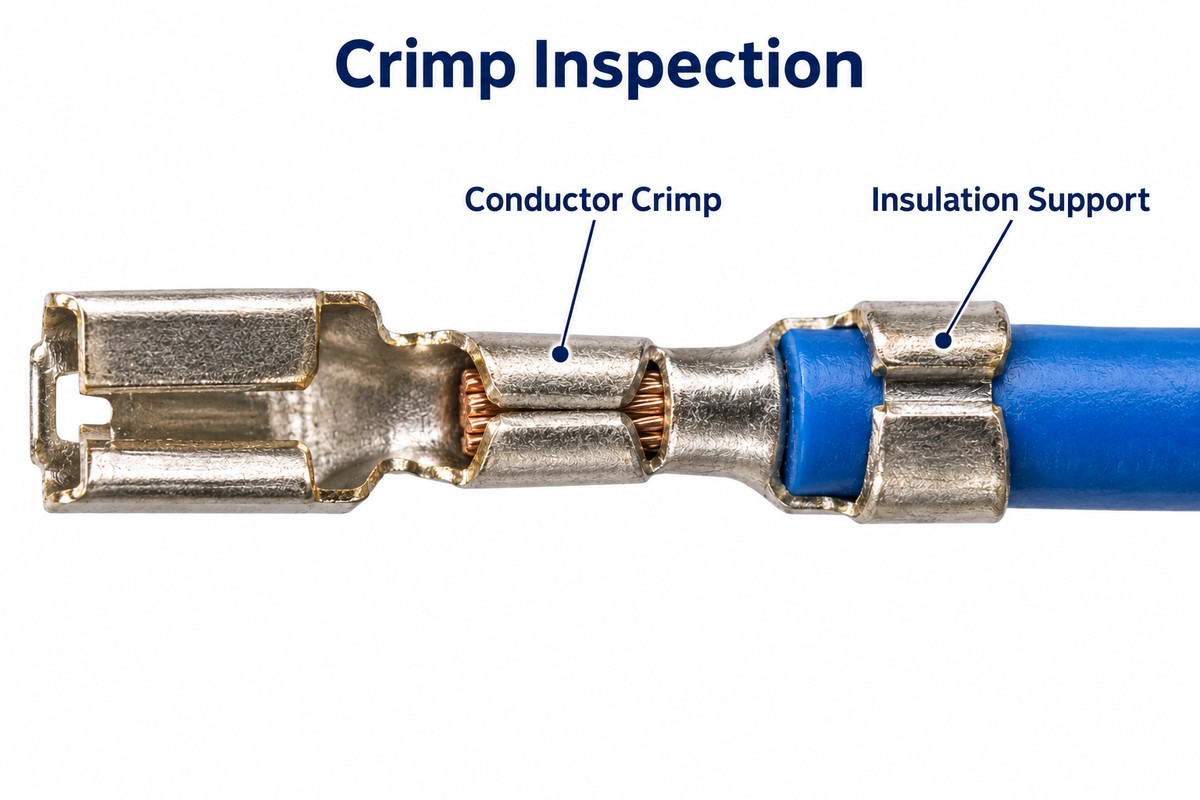
Molex’s application-tooling guidance directs users to the tooling specification for crimp height, pull force and strip length. That is a useful production discipline: a value copied from another terminal family is not a valid setup instruction merely because the wire gauge matches.
Suppose two approved 18 AWG wires have different insulation materials or strand constructions. A change between them can affect stripping and crimp formation even though both carry the same gauge designation. Review the exact combination before treating the substitution as interchangeable.
How Should Soldered Wire Terminations Be Inspected?
Inspect the wire placement, wetting, insulation condition, clearance and mechanical support around the soldered termination. A shiny surface alone does not establish a sound connection.
For a solder-cup termination, examine whether the conductor is positioned inside the cup and whether solder has joined the conductor to the terminal. Also look beyond the joint:
- Excess solder must not bridge adjacent contacts.
- Heat must not leave the wire jacket melted or displaced.
- Solder wicking should not create an unsupported rigid section where the wire must repeatedly bend.
- Sleeving must cover the intended exposed area without obstructing connector assembly.
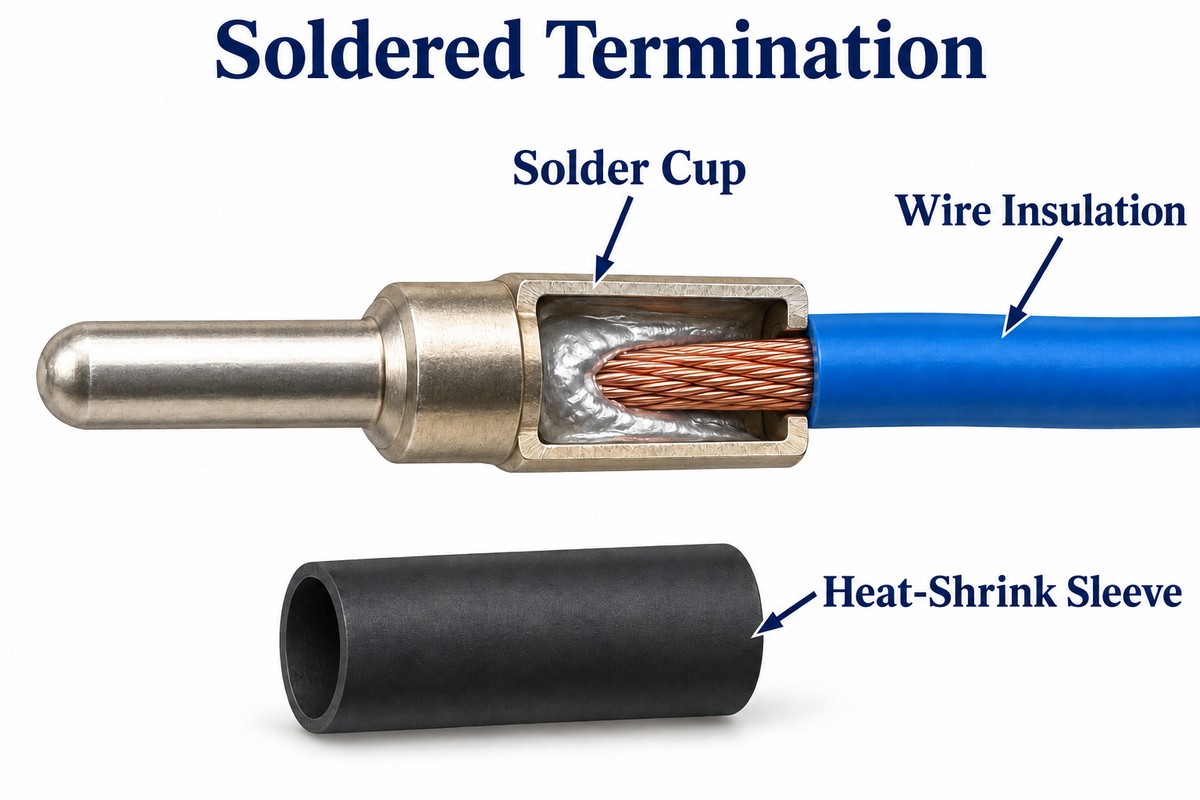
Use the applicable acceptance criteria for the actual terminal style. A cup, a turret and a through-hole board connection do not have identical geometry. When the harness is integrated with our PCB assembly service, the cable connection and board-side solder joints need their own inspection coverage.
What Connector and Routing Problems Can Inspection Miss?
A harness can have the correct pin-to-pin connections while still containing an unseated contact, an incomplete lock or a branch under mechanical strain. Electrical continuity does not reveal every assembly problem.
- Contact seating: verify that the terminal has reached its intended position and engaged the retention feature.
- Lock position: inspect the secondary lock where the connector design uses one.
- Orientation: identify the mating face and wire-entry face before checking cavity numbers.
- Routing: check branch exits, service movement and contact with sharp enclosure edges.
- Protection: confirm that ties and sleeving do not crush the jacket or leave a planned wear point exposed.
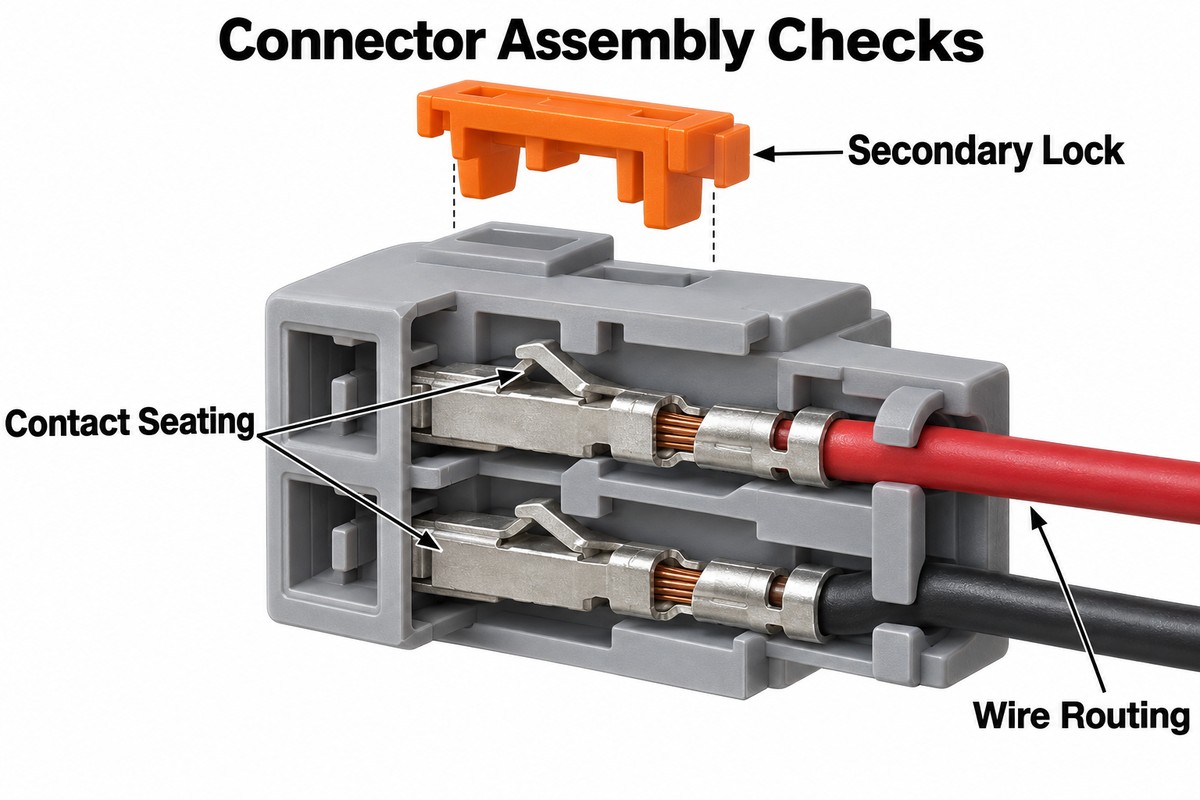
A useful first-article check is to fit the harness to its actual mating components. A flat drawing can miss an inaccessible latch or an awkward branch exit. Record any agreed routing change in the drawing rather than leaving it as an unwritten instruction to the next production operator.
Which Electrical Tests Matter for a Wire Harness?
Continuity and isolation checks verify the wiring network; insulation-resistance and dielectric-withstand tests address insulation performance when applicable. The test plan must match the assembly, including any electronic components already connected to it.
| Test | What it checks | Recorded quantity |
| Continuity | Expected pin-to-pin connections | Resistance in Ω, or connection result |
| Short-circuit check | Unintended connections between separate nets | Net-pair result against the programmed limit |
| Insulation resistance | Leakage through insulation between isolated conductors | Resistance in MΩ at a stated test voltage |
| Dielectric withstand | Ability to withstand the specified electrical stress | Voltage, leakage limit and dwell time |
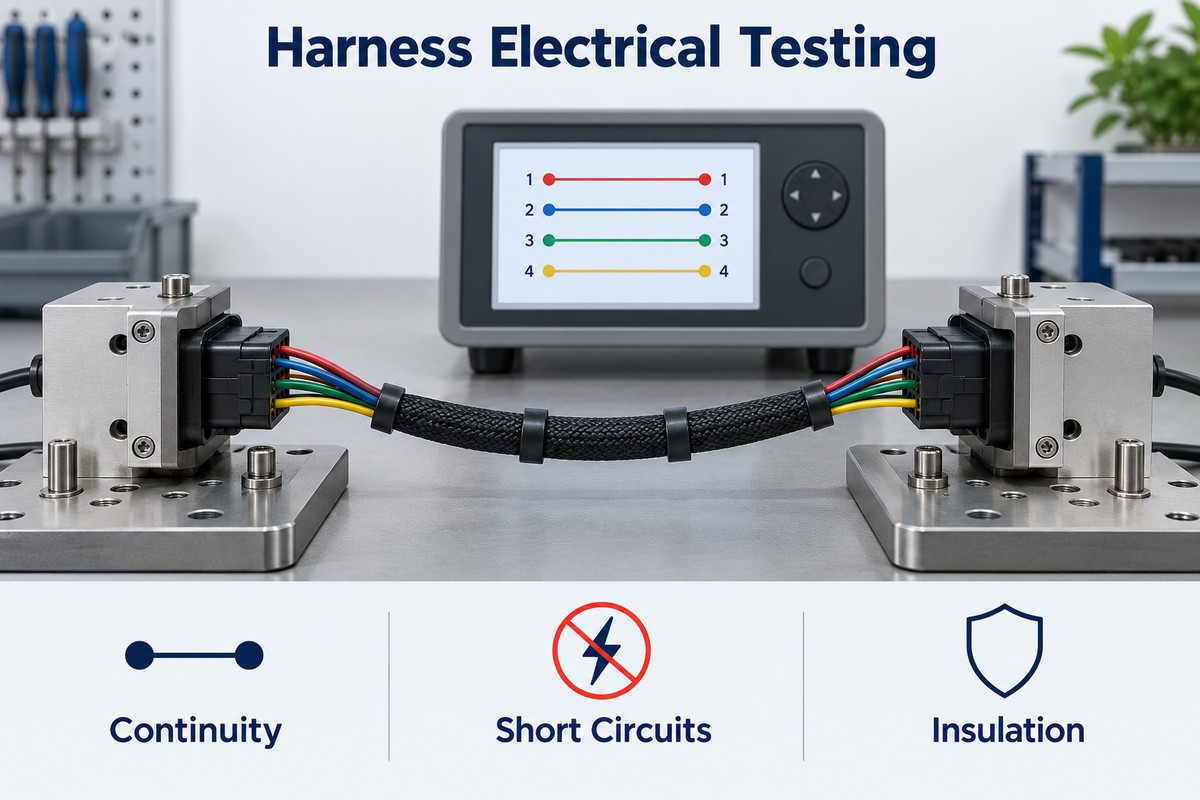
Do not copy a voltage from a generic cable-testing chart into a program for an assembly containing sensors, LEDs or protection devices. Determine whether the cable should be tested separately, which nets may be energized and what limits protect the connected components.
A simple four-wire example shows why the netlist matters: a cable can pass four individual continuity measurements yet still have two adjacent wires shorted together. The program must check intended connections and unintended connections, not only whether each wire conducts.
How Can Inspection Results Support Repeatable Production?
Connect each result to the drawing revision, component combination, setup and test program used to build the harness. A pass label without that context is difficult to investigate when a later batch behaves differently.
For a practical production record, capture:
- The harness part number, drawing revision and agreed acceptance requirements.
- The terminal and wire identifiers used for the build.
- The tooling setup and required measurements or sample tests.
- The electrical test program revision and results.
- Any rework, approved deviation and subsequent verification.
If a pull-test result deteriorates, compare it with crimp measurements and material changes. If only one connector position fails continuity, examine that cavity, its terminal and the test fixture contact. This narrows the investigation more effectively than repeating the entire assembly process without a hypothesis.
What Does IPC 620 Certification Mean?
IPC 620 certification commonly means that an individual has completed a standards-based training and assessment program, such as Certified IPC Specialist (CIS). It is different from a test report for a particular batch of cable assemblies.
The Global Electronics Association distinguishes introductory operator training from its standards-based CIS program. When checking a credential, identify the program, holder, relevant standard and current validity rather than relying on a statement that a supplier is “IPC certified.”
For purchasing, request two different kinds of evidence: personnel qualifications where your project requires them, and product-specific inspection or test records. Neither is a substitute for the other.
FAQ About IPC 620
What is the difference between IPC 610 and IPC 620?
IPC-A-610 addresses acceptance of electronic assemblies, while IPC/WHMA-A-620 focuses on cable and wire harness assemblies. An electronic product containing a PCBA and a separate harness may use both, with the applicable document identified for each assembly.
What affects IPC 620 certification cost?
IPC 620 certification cost depends on the selected program, training provider, delivery format, included modules and whether materials or examination fees are included. Request a current itemized course price; a standards-document purchase is not the same as a certification course.
Can a pull test replace visual crimp inspection?
No. A pull test measures mechanical strength under its test conditions. It does not by itself confirm correct terminal identity, insulation support, connector fit or the absence of visible damage. Use it alongside the other checks specified for the termination.
Does a Class 3 harness automatically meet every industry requirement?
No. A product class does not establish the harness’s current rating, sealing performance, chemical resistance or suitability for a specific regulated application. Those requirements depend on the design, component ratings, qualification plan and applicable customer or industry specifications.
Does a normal multimeter fully test a finished harness?
No. A multimeter can help find basic opens and incorrect connections, but it does not automatically execute a complete netlist or perform dielectric-withstand testing. Select the test equipment and fixtures from the defined test plan, particularly for multi-connector assemblies.
How Can EBest Circuit Support Your Harness and PCBA Project?
At EBest Circuit, we offer custom wire harnesses, PCB fabrication, component sourcing and PCB assembly. Bringing the cable and board requirements together helps us review connector compatibility, pin assignments and assembly access before manufacturing.
If your project specifies IPC/WHMA-A-620, send the required revision and class with your harness drawing and test requirements to sales@bestpcbs.com. We will review the scope with you and identify the manufacturing and verification requirements for your project.
Tags: ipc 620, ipc 620 certification, ipc 620 certification cost, ipc 620 class 1 2 3 definition, ipc 620 standard
PakarPBN
A Private Blog Network (PBN) is a collection of websites that are controlled by a single individual or organization and used primarily to build backlinks to a “money site” in order to influence its ranking in search engines such as Google. The core idea behind a PBN is based on the importance of backlinks in Google’s ranking algorithm. Since Google views backlinks as signals of authority and trust, some website owners attempt to artificially create these signals through a controlled network of sites.
In a typical PBN setup, the owner acquires expired or aged domains that already have existing authority, backlinks, and history. These domains are rebuilt with new content and hosted separately, often using different IP addresses, hosting providers, themes, and ownership details to make them appear unrelated. Within the content published on these sites, links are strategically placed that point to the main website the owner wants to rank higher. By doing this, the owner attempts to pass link equity (also known as “link juice”) from the PBN sites to the target website.
The purpose of a PBN is to give the impression that the target website is naturally earning links from multiple independent sources. If done effectively, this can temporarily improve keyword rankings, increase organic visibility, and drive more traffic from search results.