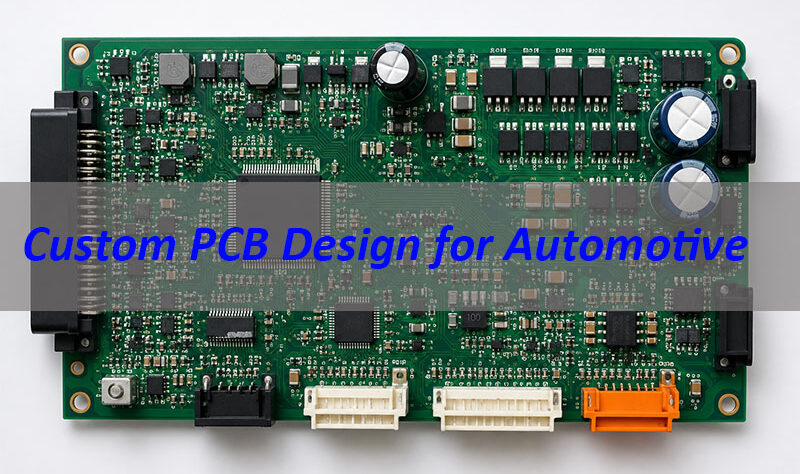
Custom PCB design for automotive means creating a circuit board that matches the electrical, thermal, mechanical, and production needs of a specific vehicle application, from control modules and BMS boards to lighting systems, radar PCBs, sensors, and power electronics.
At EBest Circuit (Best Technology), we support automotive PCB projects with DFM review, material and stackup suggestions, PCB fabrication, component sourcing, PCBA assembly, testing, and traceability, helping customers reduce design risks before production starts.
With our engineering-driven support and experience in high Tg FR4, heavy copper PCB, aluminum PCB, ceramic PCB, Rogers high-frequency PCB, and automotive-related quality control, we help customers move from prototype to stable production. If you are developing an automotive PCB project and need technical feedback before manufacturing, you can send your files or requirements to sales@bestpcbs.com for review.
What Is Custom PCB Design for Automotive?
Custom PCB design for automotive means designing a PCB for a specific vehicle application. At the same time, the board must be ready for manufacturing, assembly, inspection, and stable production.
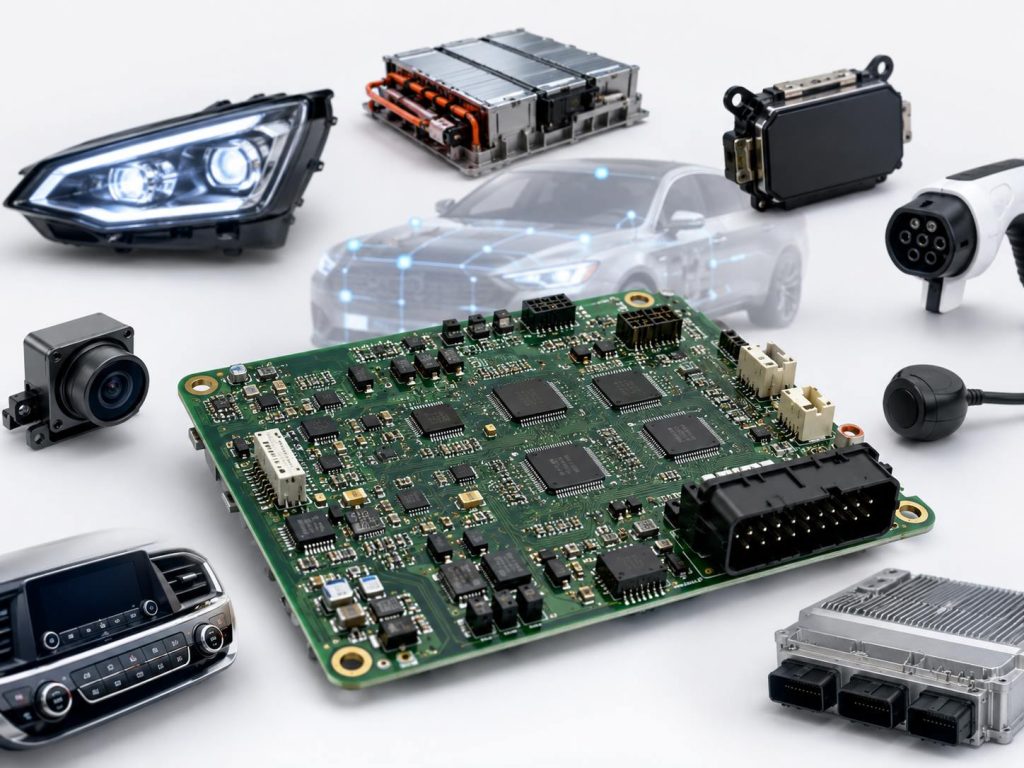
Automotive PCBs are used in lighting modules, BMS boards, radar modules, sensors, cameras, power control units, charging systems, and ADAS products. These boards often work in tough conditions. They may face heat, vibration, moisture, high current, and electrical noise. Therefore, automotive PCB design must be planned with care.
What Quality Standards Should Custom PCB Design for Automotive Follow?
Automotive PCB projects need strict quality control. Even a small PCB problem can affect system performance or long-term reliability.
One common standard is IATF 16949. It is not a PCB layout rule. Instead, it is a quality management standard for automotive production. It helps control process stability, traceability, supplier quality, and corrective actions.
In addition, automotive PCB projects may follow IPC standards, ISO systems, material rules, and customer-specific requirements.
| Standard or Requirement | Why It Matters |
|---|---|
| IATF 16949 | Supports automotive quality control and process stability |
| ISO 9001 | Builds a basic quality system for production |
| IPC-A-600 | Defines bare PCB acceptance requirements |
| IPC-A-610 | Defines PCBA acceptance requirements |
| IPC-6012 / IPC-6013 | Supports rigid PCB and flexible PCB performance |
| RoHS / REACH | Supports material compliance |
| Customer Requirements | Covers special tests, marking, packaging, and traceability |
Also, some customers may request extra reliability tests. These may include thermal cycling, vibration testing, humidity testing, solderability checks, impedance testing, and cross-section analysis.
As a result, a good supplier should do more than produce the board. It should also understand the quality path behind the project. This gives customers more confidence before prototype, trial production, and mass production.
What Engineering Documents Are Needed for Automotive PCB Production?
Automotive PCB production often needs more documents than standard PCB orders. These documents help both sides confirm the same requirements before production starts.
For early prototypes, the document package can be simple. However, for automotive production, customers may need more formal records.
Gerber Files and Fabrication Drawing
- These files define copper layers, drill data, board outline, tolerances, copper thickness, surface finish, material, and special notes.
Stackup Drawing
- This shows the layer structure, dielectric thickness, copper weight, impedance layers, and reference planes. It is important for high-speed, RF, and EMI-sensitive designs.
BOM and Assembly Drawing
- For PCBA projects, the BOM and assembly drawing confirm part numbers, placement, polarity, package size, and assembly needs.
DFM Report
- A DFM report shows possible manufacturing risks before production. It may cover trace width, spacing, hole size, via design, copper balance, solder mask clearance, and panelization.
APQP
- APQP means Advanced Product Quality Planning. It helps plan quality before production. For automotive PCB projects, it can cover material choice, process planning, testing needs, and production control.
FMEA
- FMEA helps review possible failure risks. For PCB projects, it may cover open circuits, short circuits, via cracks, plating issues, solder defects, thermal stress, and wrong components.
Control Plan
- A control plan lists what must be checked during production. It can include board thickness, copper thickness, hole size, impedance, surface finish, AOI, E-test, X-ray, and final inspection.
PPAP
- PPAP means Production Part Approval Process. It helps prove that the production process can meet customer requirements. It may include design records, process flow, FMEA, control plan, test results, sample approval, and inspection reports.
FAI Report
- First Article Inspection checks the first sample against the approved drawing, files, and specifications.
These documents reduce confusion. Also, they help customers move from samples to stable production with better control.
How Does EBest Circuit Support Custom PCB Design for Automotive with DFM Review?
DFM review is one of the most useful steps before PCB fabrication. It helps find design risks before they become production problems.
EBest Circuit (Best Technology) supports custom PCB design for automotive with practical DFM review before fabrication and assembly. The goal is to improve manufacturability, reduce redesign work, and prepare the project for production.
During DFM review, EBest Circuit can check:
- Trace width and spacing
- Drill size and annular ring
- Via type and via reliability
- Copper thickness and current capacity
- Impedance design and stackup feasibility
- Solder mask clearance
- Pad size and footprint accuracy
- Thermal relief design
- High-current copper areas
- Panelization method
- Surface finish choice
- SMT and DIP assembly risks
For example, a power board may need thicker copper and better heat paths. A radar PCB may need controlled impedance and stable materials. A lighting PCB may need an aluminum base or copper base. Also, a BMS board may need proper spacing, isolation, and traceability.
In addition, EBest Circuit can review the project from both PCB and PCBA angles. This is useful because many problems appear between fabrication and assembly. With PCB manufacturing, component sourcing, assembly, and testing support in one place, customers can reduce communication work and speed up the project.
How to Choose Materials and Stackups for Custom PCB Design for Automotive?
Material and stackup choices affect automotive PCB reliability. The right choice depends on working temperature, current load, signal speed, board size, and cost target.
- For many control boards, high Tg FR4 is a practical choice. It offers better heat resistance than standard FR4. Therefore, it is often used in sensors, control modules, interior electronics, and general vehicle electronics.
- For power boards, heavy copper PCB may be better. Thick copper helps carry higher current and spread heat. It is often used in BMS boards, motor control boards, DC-DC converters, and charging systems.
- For LED lighting and power modules, aluminum PCB or copper-based PCB can improve heat transfer. These materials help move heat away from LEDs and power components.
- For high-power or high-temperature applications, ceramic PCB may be considered. Alumina, aluminum nitride, and silicon nitride can offer stronger thermal performance.
- For radar, antenna, and high-frequency modules, Rogers or other RF materials may be used. These materials help reduce signal loss and support stable frequency performance.
| PCB Material | Common Automotive Use |
|---|---|
| High Tg FR4 | Control modules, sensors, general vehicle electronics |
| Heavy Copper PCB | BMS, motor control, power boards, charging systems |
| Aluminum PCB | LED headlights, tail lights, lighting modules |
| Copper-Based PCB | Higher power lighting and thermal products |
| Ceramic PCB | Power modules and high-temperature applications |
| Rogers RF Material | Radar, antenna, RF, and high-frequency boards |
Also, stackup design should support both performance and production. Engineers should review layer count, ground planes, power planes, impedance, copper balance, thermal path, board thickness, and spacing.
The best material is not always the most expensive one. Instead, it should match the application, reliability target, and production budget.
What Testing and Inspection Are Needed for Automotive Custom PCBs?
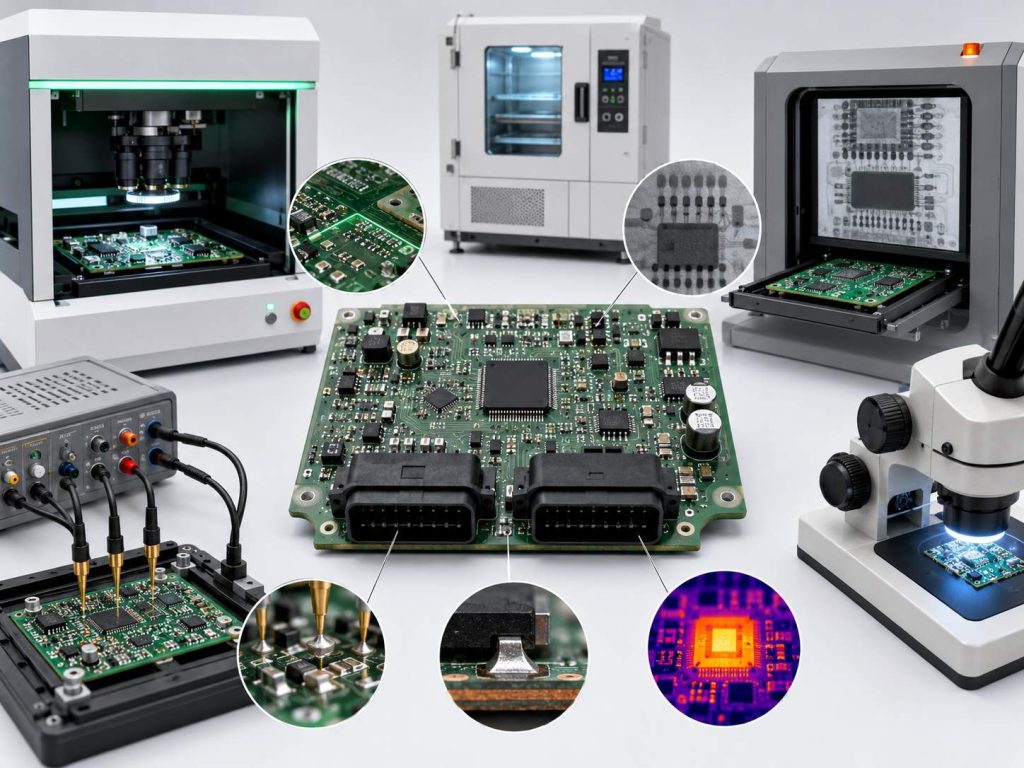
Testing and inspection help confirm that automotive custom PCBs meet the approved requirements. They also help find issues before system testing or mass production.
The test plan depends on the project. A simple control PCB may need standard electrical testing and visual inspection. However, a high-reliability automotive PCB may need more checks and records.
| Testing or Inspection Method | Purpose |
|---|---|
| AOI | Checks line defects, shorts, opens, and surface issues |
| E-test | Confirms electrical continuity and isolation |
| X-ray Inspection | Checks hidden solder joints, BGAs, and internal risks |
| Impedance Testing | Confirms controlled impedance requirements |
| Cross-Section Analysis | Checks plating, hole wall quality, and internal structure |
| Solderability Testing | Confirms pad soldering performance |
| Thermal Cycling | Checks reliability under temperature change |
| Functional Testing | Confirms that the assembled board works correctly |
| FAI | Checks the first sample against approved requirements |
| Traceability Check | Links materials, batches, process steps, and inspection records |
- For PCBA projects, assembly inspection is also important. Solder paste printing, component placement, reflow profile, polarity, solder joints, and cleaning can all affect reliability.
- In addition, traceability is important for automotive projects. Customers may need material batches, inspection records, production dates, component sources, and shipment details. Good traceability helps both sides respond faster if a quality question appears later.
EBest Circuit can support PCB fabrication, component sourcing, PCBA assembly, and testing. Therefore, customers can manage more steps through one supplier and reduce communication gaps.
Why Work with EBest Circuit for Automotive Custom PCB Design and Manufacturing?
Choosing an automotive PCB supplier is not only about price. Customers also need engineering support, material knowledge, quality control, testing ability, and stable production.
EBest Circuit (Best Technology) supports automotive PCB projects from design review to fabrication, assembly, testing, and production follow-up.
DFM Support Before Production
- EBest Circuit reviews design files before fabrication. This helps customers find risks in spacing, vias, copper, stackup, solder mask, impedance, and assembly.
Multiple PCB Technologies
- EBest Circuit can support FR4 PCB, high Tg PCB, heavy copper PCB, aluminum PCB, copper-based PCB, ceramic PCB, Rogers high-frequency PCB, and rigid-flex PCB.
Prototype to Mass Production Support
- Customers can start with samples, improve the design, move to small batches, and then prepare for mass production. As a result, the project path becomes clearer.
PCB and PCBA One-Stop Service
- EBest Circuit can provide PCB fabrication, component sourcing, SMT assembly, DIP assembly, testing, and box-build support. This helps customers reduce supplier coordination work.
Automotive Quality Support
- With quality systems such as ISO 9001 and IATF 16949, EBest Circuit can support automotive-related quality needs. The team can also work with customers on inspection records, testing plans, and traceability.
Testing and Traceability
- AOI, X-ray, E-test, impedance testing, functional testing, first article checks, and batch traceability can be arranged based on project needs.
Material and Stackup Suggestions
- EBest Circuit can help customers choose practical materials and stackups based on heat, current, signal speed, reliability, and cost.
If you are developing automotive control modules, LED lighting boards, BMS boards, radar PCBs, sensor boards, power boards, or communication modules, EBest Circuit can help review the files and support production.
To discuss your project, pls feel free to send Gerber files, BOM, drawings, stackup needs, application details, and target quantity to sales@bestpcbs.com.
FAQs About Custom PCB Design for Automotive
What makes custom PCB design for automotive different from normal PCB design?
It must consider heat, vibration, EMI, EMC, current load, material stability, testing, documents, and traceability. These needs are higher than many standard PCB projects.
Does every automotive PCB project need IATF 16949 support?
Not always. Early prototypes may not need full automotive documentation. However, production projects often benefit from IATF 16949 quality control.
What files should I provide for quotation?
You should provide Gerber files, drill files, stackup details, fabrication drawing, BOM, pick-and-place file, assembly drawing, impedance needs, copper thickness, surface finish, test needs, and target quantity.
Can EBest Circuit help if my design is not ready for production?
Yes. We can review your Gerber files, BOM, drawings, and stackup from a manufacturing point of view. Our team can provide DFM suggestions on material choice, copper thickness, drilling, solder mask, panelization, surface finish, controlled impedance requirements, and assembly risks. We do not replace circuit design or PCB layout work, but we help make the design more ready for fabrication, PCBA assembly, and production.
What materials are used in automotive custom PCBs?
Common options include high Tg FR4, heavy copper PCB, aluminum PCB, copper-based PCB, ceramic PCB, and Rogers high-frequency material. The right choice depends on the application.
Does automotive PCB production need PPAP?
Some production projects may need PPAP, especially when the PCB enters a formal automotive supply chain. The need depends on customer requirements and project risk.
Can one supplier handle PCB fabrication and PCBA assembly?
Yes. A one-stop supplier can manage PCB fabrication, component sourcing, assembly, inspection, testing, and traceability. This helps reduce communication gaps.
How can I start a custom automotive PCB project with EBest Circuit?
You can send your Gerber files, BOM, drawings, technical requirements, and application details to sales@bestpcbs.com. EBest Circuit can review your files and provide DFM, material, fabrication, assembly, and testing support.
Tags: Automotive PCB, Custom PCB Design, custom pcb design for automotive, pcb manufacturing
PakarPBN
A Private Blog Network (PBN) is a collection of websites that are controlled by a single individual or organization and used primarily to build backlinks to a “money site” in order to influence its ranking in search engines such as Google. The core idea behind a PBN is based on the importance of backlinks in Google’s ranking algorithm. Since Google views backlinks as signals of authority and trust, some website owners attempt to artificially create these signals through a controlled network of sites.
In a typical PBN setup, the owner acquires expired or aged domains that already have existing authority, backlinks, and history. These domains are rebuilt with new content and hosted separately, often using different IP addresses, hosting providers, themes, and ownership details to make them appear unrelated. Within the content published on these sites, links are strategically placed that point to the main website the owner wants to rank higher. By doing this, the owner attempts to pass link equity (also known as “link juice”) from the PBN sites to the target website.
The purpose of a PBN is to give the impression that the target website is naturally earning links from multiple independent sources. If done effectively, this can temporarily improve keyword rankings, increase organic visibility, and drive more traffic from search results.